
A recent product purchase and discovery, based on a shared customer experience and widely discussed in the public domain, has led to strong reactions. Some are calling the customer a hero.
Let’s take a real look at what happens when a concern is raised, and how systems respond.
What matters just as much as what is sold is how concerns are handled when they arise.
Before the report: the role of quality
Every organization operates with some level of quality control. But the depth and urgency of that responsibility varies by industry. In some sectors, the margin for error is smaller, and the consequences are greater.
High-scrutiny industries include:
- Food and beverage — public health risk
- Healthcare and pharmaceuticals — patient safety
- Manufacturing — product integrity, safety standards
- Transportation — human life and operational risk
- Financial services — trust, compliance, consumer protection
In these environments, quality checks are not just operational steps. They are risk management systems.
When issues are not caught early, or prevented before release, the burden shifts to the customer, the frontline team, and the response system.
When a customer raises a concern: what happens next?
Based on the customer’s account:
- A concern was raised after a product purchase
- The customer conducted their own checks to better understand the issue
- The company was contacted
- The customer reports being advised to “call back”
- Follow-up attempts were made, with challenges reaching the company once more
- At one point, the customer indicates being asked to submit email and video evidence
The customer later escalated the matter further and shared the experience publicly, which highlights how critical customer support is.
Where systems can break down
| Customer experience (reported) | What strong systems do instead |
|---|---|
| “Call back” with no clear timeline or ownership | Assign ownership immediately and define next steps |
| Multiple attempts needed to reach someone | Provide clear, reliable contact channels |
| No clear expectations set | Communicate timelines and what to expect |
| Asked to submit proof without guided follow-up | Support the customer through the process |
| Threat of social media escalation emerges | Recognize risk early and escalate internally |
| Issue moves beyond the company | Contain and address concerns before external escalation |
The risk of “call back later”
Telling a customer to call back might seem simple. But without supporting systems, it creates uncertainty, delays, increased effort for the customer, and more room for the issue to grow.
If a customer is told to call back:
- Is there a system tracking their case?
- Is there a clear point of contact?
- Is there a defined timeframe?
- Is there accountability on the company’s side?
If not, the responsibility quietly shifts back to the customer, and that’s where trust starts to weaken.
Frontline awareness matters more than we think
Another key moment from the account: the customer indicates that they mentioned taking the matter to social media, and were told to proceed.
If this reflects the interaction, the question then becomes: do frontline teams understand the risk level of certain reports?
Some concerns require different levels of priority and response. Some require immediate escalation, careful communication, and clear reassurance. This is especially true in industries tied to health, safety, and public trust.
Frontline staff don’t just respond. They signal how seriously a company takes an issue.
Handling urgent reports: what should happen
When a potentially serious concern is raised, strong systems look like this:
- Stay engaged, so the customer is not left uncertain
- Acknowledge receipt clearly
- Outline next steps
- Provide timelines for updates
- Escalate internally where needed
- Follow through with communication
Even when answers are not immediate, clarity builds trust.
Escalation beyond the company
The customer also describes reaching out to different authorities and being redirected. That opens another layer of conversation: are escalation pathways clear, not just within companies, but across systems?
When customers have to navigate multiple entities without guidance, friction increases.
From report to public reaction
Eventually, the experience was shared publicly. What followed was increased public attention, others sharing similar experiences, wider scrutiny, and strong reactions, including labeling the customer as a “hero”.
But this isn’t just about one individual. It reflects something broader:
When systems don’t respond clearly, customers will create visibility.
What this teaches us
This situation is not just about a product. It’s about quality before release, clarity in response systems, frontline awareness and escalation, and communication under uncertainty.
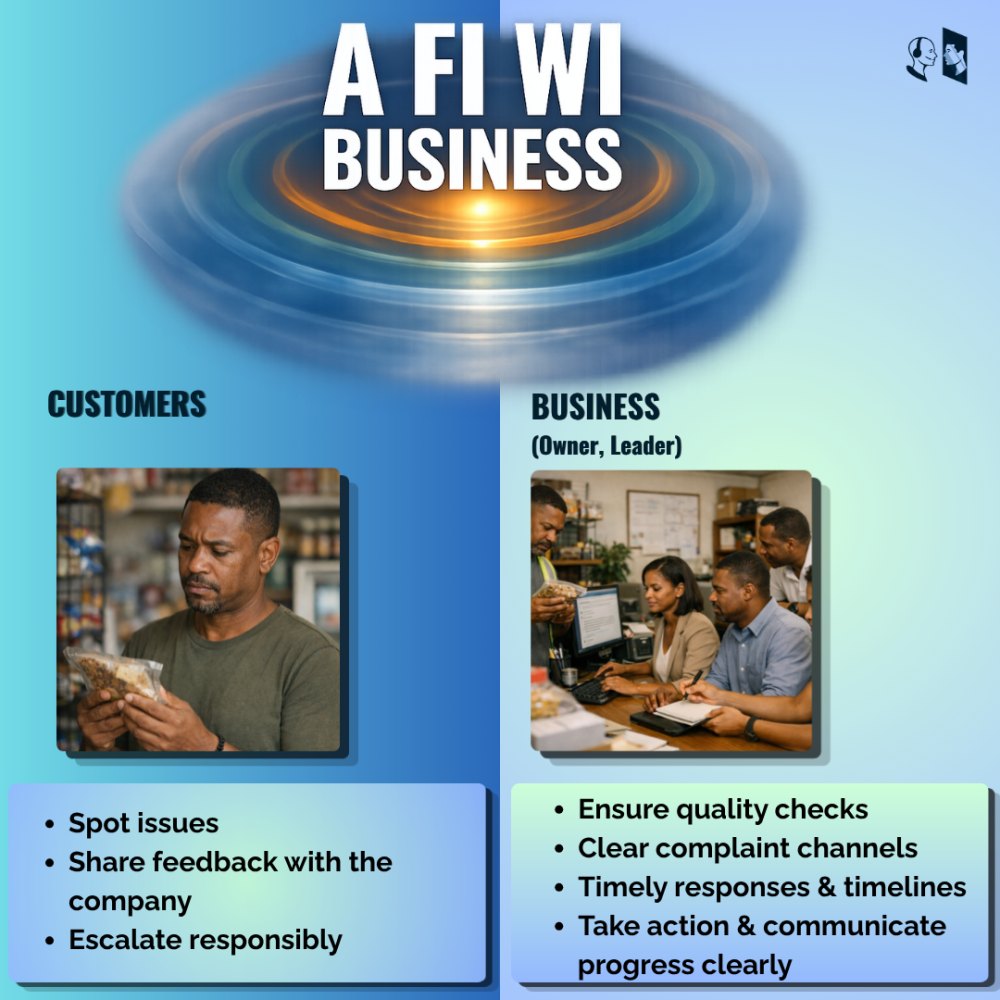
For businesses:
- Quality control must be strong enough to prevent issues where possible
- Complaint channels must be clear, accessible, and reliable
- Response systems must reduce effort, not shift it back to the customer
- Teams must understand when an issue carries higher risk
- Communication must remain consistent, especially during investigation
For customers: notice, verify where possible, raise concerns, follow through.
When a concern is raised, the goal is not just to resolve it. It’s to build trust, show accountability, and demonstrate that the system works.
In the end: customers notice. Businesses respond. Systems matter.
A fi wi business.